Blog

Resignation (solo piano, live 2021)

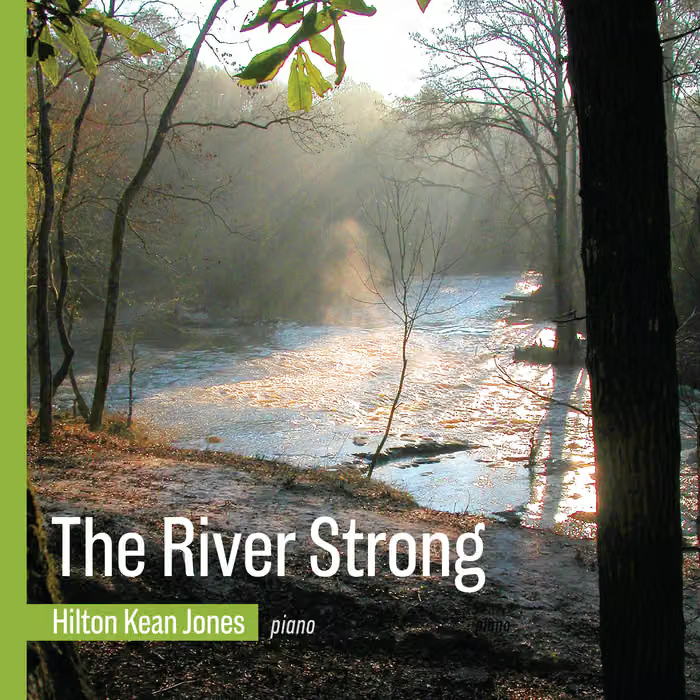
I’m finishing up posting a digital album on BandCamp of piano solo arrangements of some of my favorite Appalachian/British/Irish folk hymns. I’m able to able to post videos of my playing the tunes on BandCamp that are also available there as well as mp3 files/albums for download and streaming.

This video is from 2021, we were in the latter stages of the pandemic. I was 55 pounds heavier than I am now, but I love this particular performance so much, it’s the one I wanted to use for this new digital album (The River Strong). More about that album soon.

Ancient history…

In 1969, I became the first composition teacher at USF (also teaching theory courses and comp related courses such as orchestration). I created USF’s electronic music studio. Before, at Eastman, I had been the 1st graduate assistant assigned to build Eastman’s electronic music studio under my major professor and director of the studio, Wayne Barlow. Back in those olden days, my parent’s day (Leon Theremin, Tod Dockstader, Karlheinz Stockhausen, Pierre Schaeffer, Edgard Varèse) and then, in my day (Morton Subotnick, Wendy Carlos and others post the advent of synthesizers), it was all called “electronic music.”

Quite aside from the fact that all my current recordings use only sampled sounds, I would not consider it electronic music in the aforementioned sense. Mainly because I only use electronic sounds in lieu of acoustic instruments. I’m really writing for acoustic instruments that I can’t afford to record, so I use samples which I can.

I haven’t written any real electronic music since way back in the last century, about 1993. I’m trying to organize all the stuff I’ve written over the past years, and I keep uncovering things I’ve forgotten.

This post shares a digital album of “electronica” (see further discussion of terminology further down the post) I’d forgotten I’d done: Tales of the Laughing Wizards. That link will take you to BandCamp where you can listen to the tracks a few times free of charge. Also, I’ve given the links to the separate tracks below.

  1. Iliru
  2. Seusur
  3. Janarnkarr
  4. Calulaith
  5. Gahnende
  6. Homuro
  7. M’urneng
  8. Alrareven
  9. Lorserathathgha

Above, I referred to Tales of the Laughing Wizards as “electronica.” These days of precise music marketing terms (which is such a bother), the term “electronic music” has come to mean club music: music you can dance to. Another term, “electronica” has come to mean music produced by electronic means that is not intended as dance music. It’s music to be listened to (ambient, theatrical, contemplative, melodic, music for listening to, etc.). So, Tales of the Laughing Wizards is electronica.

Holy Manna (solo piano)

You may have noticed an acoustic piano in the background of my recordings. A couple years ago I bought what’s called a “studio upright” from the Clearwater Steinway Gallery. It’s a Boston, which is made in Asia but designed by Steinway, and a model with no plastic parts. The entire action is wood. I’m very happy with it.

I mention this because people may wonder why I don’t use that for my videos. Aside from not being a good enough pianist to record flawless videos head to tail without needing to splice together different video takes (keyboard recording permits occasional error correction…more on that in a moment), recording an acoustic piano is to my ear one of the hardest things to do well, especially for a classical sound.

The best of that I’ve ever experience was the audio engineer, John Stephan, when I recorded some of my pieces at his studio, Springs Theatre Arts & Recording, before he retired. I’ve worked in a lot of studios across the US, none compared to his technique, microphone placement, and audio environment. There’s no way I could duplicate that sound at home. I’ve got a few things I’m snobish about: authentic key lime pie, New York style cheesecake, fried fish, banana pudding, grits, and recorded piano sound.

As I mentioned above, recording tracks from a keyboard allows for a certain amount of editing without having to edit the video itself. If you look at about 00:42 from the beginning of the track, you’ll see my right hand momentarily “panic!” I had a momentary lapse of concentration. I mention this because non-musicians (unfortunately some musicians LOL) don’t know what’s going on in a performer’s head when performing.

When a musician (singers especially, but also brass instruments, pianists, conductor, everyone actually) plays/sings a note s/he must literally, mentally hear–in advance of actually playing the note–the note they’re going to play a moment later.

And if it’s a polyphonic instrumentalist like a pianist or organist or conductor all the notes being player together at that moment must be “pre-heard.” This is true even for solo instrumentalists in an orchestra. My favorite trumpet player, Don Own, talked to me once about playing in an orchestra, how an orchestra player hears their part as if they were in the audience, not from just their chair.

As you might imagine. That’s all quite a task. More than anything as I’ve aged, it’s the momentary lapses of concentration that get to me as a performer. I do silent meditation a lot. The focus required for performing music is like that. It’s why being a musician is so addictive. Few things match the rush.

Reblog of my sister’s Father’s Day post!

Wendeyaho (solo piano) 2026

This Native-American melody is so awesome. It’s indelible. I hope my arrangement does it justice.

The solo piano sheet music (that I’m playing from in the above video) is available at https://www.sheetmusicdirect.com/en-US/se/ID_No/1084679/Product.aspx and https://www.sheetmusicplus.com/title/wendeyaho-for-solo-piano-digital-sheet-music/22102384 .

The description there reads: I’ve given this Native-American morning song a reverential treat, with four statements, each with a different musical texture corresponding to the directions east, west, north, and south. For the student learning this piece, the issues to be confronted are controlling the interpretive dynamic and tempo arch of each of the four statements and of the four as a unit. The third statement also presents the opportunity to learn how to distribute the notes of the melodic line between to two hands in order to have three contrapuntal lines.

I also published a choral version of this published May 12, 2023, available at https://www.sheetmusicdirect.com/en-US/se/ID_No/1327199/Product.aspx and https://www.sheetmusicplus.com/title/wendeyaho-digital-sheet-music/22502871. It’s for 2-part mixed choir (treble voices and baritone voices) with keyboard accompaniment. It’s extremely easy, to be filed under “Emergency Anthem for when less than half the choir shows up on Sunday morning.”

My first release of this was 12/7/21, on the digital album, simple songs (https://open.spotify.com/track/6OVBCYsivHznjvMnNZ0CQ3?si=f3e58d42d1d447e1) as a solo piano with orchestrated background. (Please let me know if that link doesn’t work! LOL)

The Little Room Under the Stairs

We lived in an old, rambling two-storied* parsonage (my father was a Methodist minister) and we lived in the house owned by the church. I was in the first year or two of elementary school. Our house was big enough that there were front stairs descending into the hallway just inside the mudroom and stairs in the back emptying directly from my bedroom (!), down into the kitchen and continuing directly on down into the the basement (but that’s another story ).

Underneath of the angle of the front stairs was a triangular shaped little room with its own little triangular door.

I don’t remember if I ever actually ever even entered that room, or if I simply wanted to and fantasized about doing so. Memory is a very malleable thing. My emotional association with that room was not at all like the frightening little room under the stairs that Harry Potter was confined to. For me, the association with our little room under the stairs is warmth, comfort, books, a place to be away from the world and close the door behind me, a place all my own…emotional privacy.

I suspect that’s a false memory, built entirely of wishful fantasy.

Here’s a picture of me on the front porch of that old house, at that exact age, 8. You can probably intuit all there is to know about me just from that photo!

Fire of Justice, Fire of Love (choir, organ, & trumpet)

If you’re a church choir director, this is a good number for Pentecost. It can be done a number of ways: the basic configuration is the congregation and choir (in unison) singing the short refrain (a bulletin insert graphic comes with the choir parts) and the choir, or a section of the choir, or a soloist singing the refrains. The trumpet descant may be played on any soprano solo melody instrument, or if necessary by the organist (organists know what to do in order to do this).

I’m pleased to finally be able to have a demo of this version with full orchestration using the Cantai synth voices. There’s also a good video demo of the Lakewood UCC choir doing it as just a simple hymn. I like it that way ever bit as much as this fancy “downtown” version with organ and trumpet.

I write lots of secular music and arrangements, too. But, I’m honored even as an octogenarian to be able to have a church music director/keyboardist position. Bach, Mozart, Palestrina, Handel all had jobs as church musicians. It’s heartening to realize that even they had to get up early on Sunday mornings!

Sheet Music available from
https://www.sheetmusicdirect.com/en-US/se/ID_No/1226200/Product.aspx
and
https://www.sheetmusicplus.com/title/fire-of-justice-fire-of-love-digital-sheet-music/22380866.

#music #organ #trumpet #choir #church #sacred

Carol of the Birds (Curoo, Curoo)

It’s Eastertide, nevertheless, this wonderful Irish Christmas carol from the 1800s, was the next on my project list: getting caught up on posting all my choral pieces and arrangements to Hal Leonard’s ArrangeMe.com. Part of that getting caught up is making score videos and posting here, as well as getting the links inserted on my Compositions page. When ArrangeMe gives me the publication links, I post those to YT, IG (personal & business), and here.

That’s part of my cycle of completion. I remember reading Stephan King—in his book on writing I think it was—that he wondered if writing weren’t some sort of physical compulsion. That the hand needed to be putting words on the page. For me, writing pieces and arrangements are times when I lose complete sense of time, even hunger. And I’m not able to turn that compulsion off until I’ve completed the cycle. Getting audio and score and links posted (a tangible record of the effort), such as this post, completes the cycle.

So…thanks for putting up with my compulsion!

We Come to Sing Our Joyful Songs

Robert Helps, a friend, amazing concert pianist, and several times roommate, told me once that when he hit a dry spell as a composer he moved to doing lots of accompanying of vocalists. Years in fact. It was part of a larger conversation about the unevenness of famous composers. He pointed out that the output of composers tended to come in clumps. They didn’t have a tidy schedule of releases as corporate pop groups do today.

I’ve hit a dry spell of my own. Partly being 81, partly feeling my way toward myself own compositional growth (that’s not a conscious process!), and partly feeling completely irrelevant in a TikTok algorithmic world.

I’m not the pianist Bob was by a long shot, but I do have my own skill set which includes enjoying arranging folk tunes (happens to be my best sellers actually), so while I wait for my unconsciousness to sort out where I’m headed compositionally, I’m devoting myself to arranging folks tunes. Here’s one that’s fun to sing with a choir.

The original folk tune’s range is an octave and a fourth; too wide for the average church choir singer. So, my main task was finding ways to fold the tune upon itself to stay within a 6th or 7th and still have it feel as if that that’s the way it always was! The accompanying optional instrumental obbligato has the tune in it’s original form (slightly embellished) if you’re curious about the details.

Sheet music available at
https://www.sheetmusicdirect.com/en-US/se/ID_No/1978549/Product.aspx and
https://www.sheetmusicplus.com/en/product/we-come-to-sing-our-joyful-songs-23701516.html.

Be Still and Know That I Am God

Waaaay back in 1993 when I wrote this, it was written for a men’s chorus (TTBB) and performed at USF, Dr. John Richmond conducting (the piece is dedicated to John who was a supporter of mine in a department in which I had few supporters…I am forever grateful to him and a those few other friends).

Unfortunately, that concert was not recorded so I don’t have a record of it. I can’t find the original TTBB score either. But, at some point before that score was lost, I made a SATB version of the piece. It works well as a solo madrigal type group, or a full chorus.

This is another of those cyber choral renditions. PLEASE remember that the reason I’m using these cyber choirs tracks is to have demos to go with the scores on sale at sheetmusicdirect, etc. They’re not intended to be “real” music recodings.

My only hope is that some choir director will elect to perform and record the piece(s) out of pity for the world so these cyborgs can disppear, replaced by real humnas making music.

PS: I do wish the soprano had less of a vibrato, and the tenor a bit more. The score has a keyboard, preferably for rehearsal only.