Sheet music for all the titles avabile at sheetmusicdirect and sheetmusicplus. As I remember all the links also have videos. There’s a limited number of free screenings (3?) for all titles for both the audio and the videos.
As an undergraduate at the University of the Pacific Conservatory of Music, my composition teacher was Stanworth Beckler. I learned so much from him. As with all real learning it’s not the information that’s presented in lessons and lectures, it’s the off-hand comment, almost in passing that sticks with you and guides and comforts you decades later. Several of his stick with me to this day.
Beckler taught a course one semester that was the result of his own in-depth study and analysis of ALL of the compositions of Igor Stravinsky. What a course! For the longest time I carefully kept his handouts. But…life. I no longer have them. If there’s any Beckler students out there who have those notes I will happily pay for their duplication and postage. They’re priceless.
Anyway…After listening to the complete works of Stravinsky over a semester and hearing Beckler’s analyses, one day I had the distinct impression that Stravinsky’s oeuvre is his own self-instruction in how to write music. That may seem like a peculiar observation for someone who wrote The Rite of Spring; he knew how to write music! But, alas, you have to learn all over again, every piece, no matter how long you’ve been doing it, ever since we entered the non-common-practice period (pretty much post Wagner to the present day).
I too am still trying to figure out how to compose and each piece I try to chip away at a new skill a little bit. (No, I won’t tell which skill it is for this piece.)
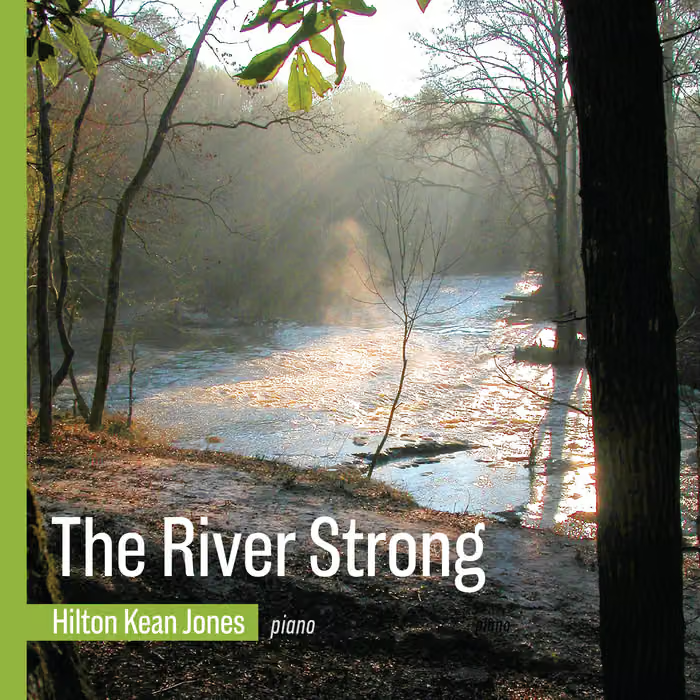
I’m finishing up posting a digital album on BandCamp of piano solo arrangements of some of my favorite Appalachian/British/Irish folk hymns. I’m able to able to post videos of my playing the tunes on BandCamp that are also available there as well as mp3 files/albums for download and streaming.
This video is from 2021, we were in the latter stages of the pandemic. I was 55 pounds heavier than I am now, but I love this particular performance so much, it’s the one I wanted to use for this new digital album (The River Strong). More about that album soon.
You may have noticed an acoustic piano in the background of my recordings. A couple years ago I bought what’s called a “studio upright” from the Clearwater Steinway Gallery. It’s a Boston, which is made in Asia but designed by Steinway, and a model with no plastic parts. The entire action is wood. I’m very happy with it.
I mention this because people may wonder why I don’t use that for my videos. Aside from not being a good enough pianist to record flawless videos head to tail without needing to splice together different video takes (keyboard recording permits occasional error correction…more on that in a moment), recording an acoustic piano is to my ear one of the hardest things to do well, especially for a classical sound.
The best of that I’ve ever experience was the audio engineer, John Stephan, when I recorded some of my pieces at his studio, Springs Theatre Arts & Recording, before he retired. I’ve worked in a lot of studios across the US, none compared to his technique, microphone placement, and audio environment. There’s no way I could duplicate that sound at home. I’ve got a few things I’m snobish about: authentic key lime pie, New York style cheesecake, fried fish, banana pudding, grits, and recorded piano sound.
As I mentioned above, recording tracks from a keyboard allows for a certain amount of editing without having to edit the video itself. If you look at about 00:42 from the beginning of the track, you’ll see my right hand momentarily “panic!” I had a momentary lapse of concentration. I mention this because non-musicians (unfortunately some musicians LOL) don’t know what’s going on in a performer’s head when performing.
When a musician (singers especially, but also brass instruments, pianists, conductor, everyone actually) plays/sings a note s/he must literally, mentally hear–in advance of actually playing the note–the note they’re going to play a moment later.
And if it’s a polyphonic instrumentalist like a pianist or organist or conductor all the notes being player together at that moment must be “pre-heard.” This is true even for solo instrumentalists in an orchestra. My favorite trumpet player, Don Own, talked to me once about playing in an orchestra, how an orchestra player hears their part as if they were in the audience, not from just their chair.
As you might imagine. That’s all quite a task. More than anything as I’ve aged, it’s the momentary lapses of concentration that get to me as a performer. I do silent meditation a lot. The focus required for performing music is like that. It’s why being a musician is so addictive. Few things match the rush.
The description there reads: I’ve given this Native-American morning song a reverential treat, with four statements, each with a different musical texture corresponding to the directions east, west, north, and south. For the student learning this piece, the issues to be confronted are controlling the interpretive dynamic and tempo arch of each of the four statements and of the four as a unit. The third statement also presents the opportunity to learn how to distribute the notes of the melodic line between to two hands in order to have three contrapuntal lines.
We lived in an old, rambling two-storied* parsonage (my father was a Methodist minister) and we lived in the house owned by the church. I was in the first year or two of elementary school. Our house was big enough that there were front stairs descending into the hallway just inside the mudroom and stairs in the back emptying directly from my bedroom (!), down into the kitchen and continuing directly on down into the the basement (but that’s another story ).
Underneath of the angle of the front stairs was a triangular shaped little room with its own little triangular door.
I don’t remember if I ever actually ever even entered that room, or if I simply wanted to and fantasized about doing so. Memory is a very malleable thing. My emotional association with that room was not at all like the frightening little room under the stairs that Harry Potter was confined to. For me, the association with our little room under the stairs is warmth, comfort, books, a place to be away from the world and close the door behind me, a place all my own…emotional privacy.
I suspect that’s a false memory, built entirely of wishful fantasy.
Here’s a picture of me on the front porch of that old house, at that exact age, 8. You can probably intuit all there is to know about me just from that photo!
I’m in the process of doing the necessary work to distribute three new digital albums to the various streaming services. Part of that is visiting the four previous albums of mine that are already distributed to see if they’re so awful I should just pay to have them deleted from distribution (it’s something that you can do). That entails listing to them with new ears.
While doing so, I realized I still like what I did on this album, in particular this tune, Resignation.
Here’s a link to the complete album you can listen to YouTube Music.
Hal Leonard, the world’s largest sheet music publisher, runs a site called ArrangeMe which gives composers & arrangers a vehicle to self publish their arrangements of pop tunes–Hal Leonard owns the rights to a vast number of pops songs all of which are available to arrange through ArrangeMe–and of tunes in the public domain. As well, it provides a self-publishing platform for composers of their original works. When there’s a sale, the composer or arranger make a percentage and Hal Leonard gets a percentage.
If you go to the Compositions page of my website, you’ll links to those two sites for almost all of my compositions that are for instrumental solos, piano solos, organ solos, and choral/vocal music. (I don’t bother trying to sell scores of my symphonic music and concerti since those are not really something people are shopping for.)
Pianists seem to buy my folk song and hymn tune arrangements and organists my original music although that’s not always the case. It’s not gonna pay my mortgage, but I do make steady sales. My videos on YouTube (https://www.youtube.com/@hiltonkeanjones) are my main channel for promoting my music. There’s probably other ways that would increase sales, but I’m not business savvy. Suggestions always welcome!
I love this tune: Sweet Rivers. The composer of the tune is anonymous and the tune is found in William Walker’s 1835 Souther Harmony, and Musical Coompanion. I could play it over and over again. It makes me happy and makes me smile. Check out the words and various instances of the tune in different hymnals at https://hymnary.org/text/sweet_rivers_of_redeeming_love. This is real old-timey music at its best.
My dear friend, William Lindsay, who died November of ’24 after a long, progressive battle with dementia and Parkinson’s, used to tell me whenever I was in the clutches of melancholy, “look up.” He mean it literally as well as figuratively. It worked every time, and still does. Somehow just the physical act of looking up at whatever there is to see, the mind is diverted from the unwanted thoughts. Clouds, tops of trees, birds flying, tall buildings, stars, the sun, sunrise colors, sunsets, the cerulean sky…doesn’t matter, even a telephone pole will do.
That’s what this album of piano pieces is all about, and it’s dedicated to Bill.