If you’re a church choir director, this is a good number for Pentecost. It can be done a number of ways: the basic configuration is the congregation and choir (in unison) singing the short refrain (a bulletin insert graphic comes with the choir parts) and the choir, or a section of the choir, or a soloist singing the refrains. The trumpet descant may be played on any soprano solo melody instrument, or if necessary by the organist (organists know what to do in order to do this).
I’m pleased to finally be able to have a demo of this version with full orchestration using the Cantai synth voices. There’s also a good video demo of the Lakewood UCC choir doing it as just a simple hymn. I like it that way ever bit as much as this fancy “downtown” version with organ and trumpet.
I write lots of secular music and arrangements, too. But, I’m honored even as an octogenarian to be able to have a church music director/keyboardist position. Bach, Mozart, Palestrina, Handel all had jobs as church musicians. It’s heartening to realize that even they had to get up early on Sunday mornings!
It’s Eastertide, nevertheless, this wonderful Irish Christmas carol from the 1800s, was the next on my project list: getting caught up on posting all my choral pieces and arrangements to Hal Leonard’s ArrangeMe.com. Part of that getting caught up is making score videos and posting here, as well as getting the links inserted on my Compositions page. When ArrangeMe gives me the publication links, I post those to YT, IG (personal & business), and here.
That’s part of my cycle of completion. I remember reading Stephan King—in his book on writing I think it was—that he wondered if writing weren’t some sort of physical compulsion. That the hand needed to be putting words on the page. For me, writing pieces and arrangements are times when I lose complete sense of time, even hunger. And I’m not able to turn that compulsion off until I’ve completed the cycle. Getting audio and score and links posted (a tangible record of the effort), such as this post, completes the cycle.
Robert Helps, a friend, amazing concert pianist, and several times roommate, told me once that when he hit a dry spell as a composer he moved to doing lots of accompanying of vocalists. Years in fact. It was part of a larger conversation about the unevenness of famous composers. He pointed out that the output of composers tended to come in clumps. They didn’t have a tidy schedule of releases as corporate pop groups do today.
I’ve hit a dry spell of my own. Partly being 81, partly feeling my way toward myself own compositional growth (that’s not a conscious process!), and partly feeling completely irrelevant in a TikTok algorithmic world.
I’m not the pianist Bob was by a long shot, but I do have my own skill set which includes enjoying arranging folk tunes (happens to be my best sellers actually), so while I wait for my unconsciousness to sort out where I’m headed compositionally, I’m devoting myself to arranging folks tunes. Here’s one that’s fun to sing with a choir.
The original folk tune’s range is an octave and a fourth; too wide for the average church choir singer. So, my main task was finding ways to fold the tune upon itself to stay within a 6th or 7th and still have it feel as if that that’s the way it always was! The accompanying optional instrumental obbligato has the tune in it’s original form (slightly embellished) if you’re curious about the details.
Waaaay back in 1993 when I wrote this, it was written for a men’s chorus (TTBB) and performed at USF, Dr. John Richmond conducting (the piece is dedicated to John who was a supporter of mine in a department in which I had few supporters…I am forever grateful to him and a those few other friends).
Unfortunately, that concert was not recorded so I don’t have a record of it. I can’t find the original TTBB score either. But, at some point before that score was lost, I made a SATB version of the piece. It works well as a solo madrigal type group, or a full chorus.
This is another of those cyber choral renditions. PLEASE remember that the reason I’m using these cyber choirs tracks is to have demos to go with the scores on sale at sheetmusicdirect, etc. They’re not intended to be “real” music recodings.
My only hope is that some choir director will elect to perform and record the piece(s) out of pity for the world so these cyborgs can disppear, replaced by real humnas making music.
PS: I do wish the soprano had less of a vibrato, and the tenor a bit more. The score has a keyboard, preferably for rehearsal only.
You’ve heard me mention the Hal Leonard website, ArrangeMe.com. I’ve been looking at my sales over the past 3 years and most of my sales have been my piano arrangements of folk music. These two arrangements are part of an desire to expand my trend into choral music. It’s the first time I’ve ever take advantage of the 6+million tunes Hal Leonard owns the rights to.
I picked these two tunes because their folk flavor, but mainly because Pete Seeger is an important part of the social justice conscience of America and America needs that message more than ever.
Both these tunes are arranged for SAB which makes them suitable for a public school choir. Even though Turn, Turn, Turn is based on Ecclesiastes, it’s still appropriate for a secular context. I’m fortunate that the church where I’m music director (Lakewood UCC) appreciates the spiritual messages reflected in many secular songs. The Lakewood choir has sung both these arrangements in services.
The sheet music for these two arrangements are available at…
I’m You can listen to demos of the songs at all those links as well as peruse the scores, entirely free. And if you want to perform them with your choir, you can download them right there!
The choir at Lakewood UCC, where I’m the music director, did this last year and they did a terrific job. I changed four measures of the final score so I couldn’t use the tape of their live performance for the demo of the sheet music or I would have. They did that good of a job. The Cantai synth voices will have to do for the purposes of demon.
The text I cobbled together from various sources: Salisbury Book of Hours, 1514 (ref: Mark 12:30 and Psalm 40:8), various ancient Irish sources (Carmina Gadelica, Bridgid of Gael, other traditional Gaelic verses) plus original text of my own.
This is a very easy choral piece: just two parts, women and men…not even any chords. The range of the parts is narrow which keeps the sound good.
The issues coming from “AI” actually began a long time ago before the notion of AI even existed, with the advent of recordings. Up until then, music meant people in a room makes sounds for folks to enjoy hearing. I still believe that is the purpose of music.
But, with recordings came music preserved as if in amber. Suddenly every pianist is compared to Horowitz, every composer to Beethoven. At the same time, we’re blessed with getting to hear Horowitz (I never had the privilege to hear him in person) and I’ve only ever heard a select few of Beethoven’s symphonies performed, live.
So there’s these two parallel steams of musical existence: recordings and live performance. They intersect. I first heard Stravinsky’s Rite of Spring on records. When I was a kid, you could go in a record store and listen to any record in the store in listening booths. I spent hours in the St. Louis Stix, Baer, and Fuller department store listening to that piece. Had records not existed, I would never have heard it. Much, much later I heard it live. There’s no comparison. I heard things in the live performance—little inner voices wiggling around—that, even though I’d studied the score, I never really “heard” before.
Then came electronic music: the Hammond Organ, musique conrète, the Theremin, Oscar Sala, Karlheinz Stockhausen, the Columbia-Princeton electronic music studio, Bob Moog. All of which, progressed to keyboards in almost every home, and then home studios, now all residing in a laptop that plays sampled sound in convincing combinations.
How does this related to AI and the schlock AI generated (I won’t say “composed”) songs on streaming services? It leaves humans out of the equation.
There’s an ethical dilemma for me. Where do I draw the line. I created this demo of a song I wrote to my sister’s lyrics using a piece of software called “Cantai.” It sings the words. It bothers me that that’s a group of singers that won’t be singing that song. That’s a group of instrumentalists that won’t be playing violins, a piano, a glockenspiel, and fretless bass. A recording studio won’t have the income from me renting time, paying for musicians.
But then…I can’t afford to hire a studio, hire vocalists, instrumentalists. I salve my conscience by telling myself I’m making demos to hopefully convince some real human to perform my music. The pretend world of sampled sounds are as close as I’m going to come to getting to experience most of my music.
A good friend who devoted his life to designing and building important pipe organs in Texas and throughout the south despaired when he heard sampled organ sounds that he spent his life perfecting. What of the organs and organ builders whose sounds were robbed (sampled) for me to use on my laptop?
Fortunately, AI “composed” music and synthesized/sampled electronic sounds do not compare to the real thing. It’d be nice to think they’d never will, but someday in a Star Trek world they may. I’m glad Data realized that making music meant folks (including androids), in a room (perhaps on a starship), making sounds in the physical world for folks (and androids) to hear and enjoy, and to enjoy performing! My sister’s words paint a truth that aligns with that notion of what real music really is.
I guess I’m still not convinced we’re lucky the automobile was invented to replace the horse and buggy…for that matter, maybe the invention of the wheel wasn’t such.a good idea, either.
I’m in the process of doing the necessary work to distribute three new digital albums to the various streaming services. Part of that is visiting the four previous albums of mine that are already distributed to see if they’re so awful I should just pay to have them deleted from distribution (it’s something that you can do). That entails listing to them with new ears.
While doing so, I realized I still like what I did on this album, in particular this tune, Resignation.
Here’s a link to the complete album you can listen to YouTube Music.
Hal Leonard, the world’s largest sheet music publisher, runs a site called ArrangeMe which gives composers & arrangers a vehicle to self publish their arrangements of pop tunes–Hal Leonard owns the rights to a vast number of pops songs all of which are available to arrange through ArrangeMe–and of tunes in the public domain. As well, it provides a self-publishing platform for composers of their original works. When there’s a sale, the composer or arranger make a percentage and Hal Leonard gets a percentage.
If you go to the Compositions page of my website, you’ll links to those two sites for almost all of my compositions that are for instrumental solos, piano solos, organ solos, and choral/vocal music. (I don’t bother trying to sell scores of my symphonic music and concerti since those are not really something people are shopping for.)
Pianists seem to buy my folk song and hymn tune arrangements and organists my original music although that’s not always the case. It’s not gonna pay my mortgage, but I do make steady sales. My videos on YouTube (https://www.youtube.com/@hiltonkeanjones) are my main channel for promoting my music. There’s probably other ways that would increase sales, but I’m not business savvy. Suggestions always welcome!
I love this tune: Sweet Rivers. The composer of the tune is anonymous and the tune is found in William Walker’s 1835 Souther Harmony, and Musical Coompanion. I could play it over and over again. It makes me happy and makes me smile. Check out the words and various instances of the tune in different hymnals at https://hymnary.org/text/sweet_rivers_of_redeeming_love. This is real old-timey music at its best.
My dear friend, William Lindsay, who died November of ’24 after a long, progressive battle with dementia and Parkinson’s, used to tell me whenever I was in the clutches of melancholy, “look up.” He mean it literally as well as figuratively. It worked every time, and still does. Somehow just the physical act of looking up at whatever there is to see, the mind is diverted from the unwanted thoughts. Clouds, tops of trees, birds flying, tall buildings, stars, the sun, sunrise colors, sunsets, the cerulean sky…doesn’t matter, even a telephone pole will do.
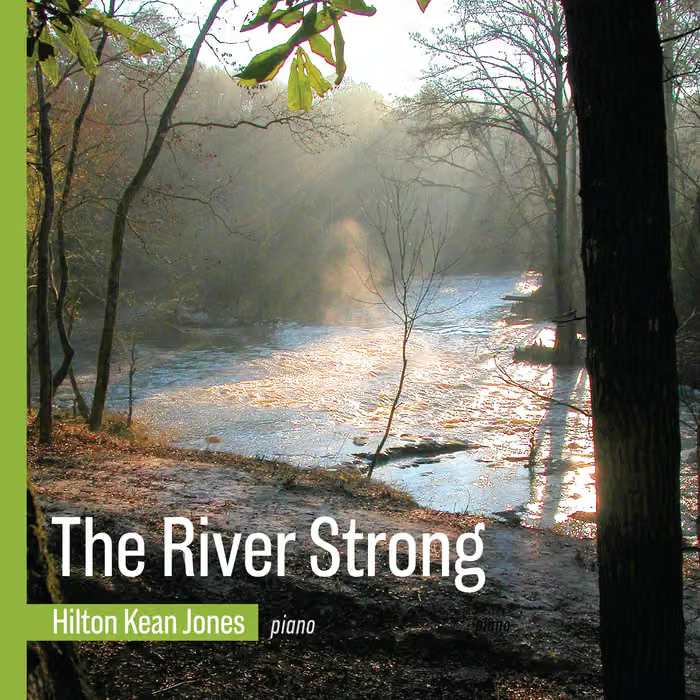
That’s what this album of piano pieces is all about, and it’s dedicated to Bill.